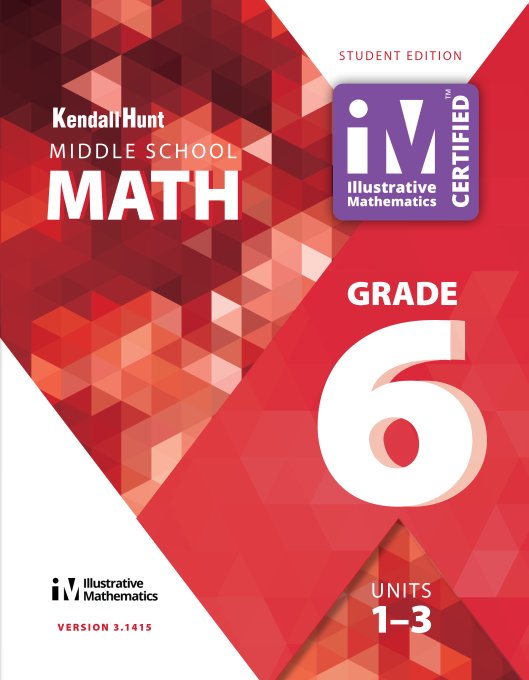
Kendall Hunt's Illustrative Mathematics 6-8 Math
Ratings Snapshot
Grade band| 6-8 | |
|---|---|
| Gateway 1 | |
| Gateway 2 | |
| Gateway 3 |
Gateway Ratings Summary
Focus & Coherence
›1bIndicator 1b4/4Meets· EdReports 4/4✓Instructional material spends the majority of class time on the major cluster of each grade.
The materials (IM Math) are structured so each grade has 8-9 units with 8-28 lessons each, where instructional activities 'are the heart of the mathematical experience and make up the majority of the time spent in class' [E2][E4][E5], indicating extensive grade-level work. Assessments and the end-of-course resources explicitly target 'the major work of the grade' [E3], and units map to standards progressions to ensure full intent of grade-level standards [E9][E12]. Centers and fluency work reinforce and build grade-level standards and fluencies rather than displacing them [E1][E7][E8], so off-grade content does not detract from grade-level focus. This structural evidence supports both required components — extensive grade-level problems and full intent of standards.
Cited evidence (12)
- E1 · k5-teacher-guide — im.kendallhunt.com/k5/teachers/teacher-guide/how-to-use-the-materials.htmlrel 0.49
- E2 · k5-teacher-guide — im.kendallhunt.com/k5/teachers/teacher-guide/a-typical-im-lesson.htmlrel 0.47
- E3 · k5-teacher-guide — im.kendallhunt.com/k5/teachers/teacher-guide/summative-assessments.htmlrel 0.46
- E4 · k5-teacher-guide — im.kendallhunt.com/k5/teachers/teacher-guide/about-these-materials.htmlrel 0.46
- E5 · ms-teacher-guide — im.kendallhunt.com/MS/teachers/typical_lesson.htmlrel 0.44
- E6 · ms-teacher-guide — im.kendallhunt.com/MS/teachers/about.htmlrel 0.43
- E7 · k5-teacher-guide — im.kendallhunt.com/k5/teachers/teacher-guide/how-to-use-the-materials.htmlrel 0.42
- E8 · k5-teacher-guide — im.kendallhunt.com/k5/teachers/teacher-guide/summative-assessments.htmlrel 0.41
- E9 · k5-teacher-guide — im.kendallhunt.com/k5/teachers/teacher-guide/about-these-materials.htmlrel 0.40
- E10 · k5-teacher-guide — im.kendallhunt.com/k5/teachers/teacher-guide/a-typical-im-lesson.htmlrel 0.39
- E11 · ms-teacher-guide — im.kendallhunt.com/MS/teachers/about.htmlrel 0.38
- E12 · k5-teacher-guide — im.kendallhunt.com/k5/teachers/teacher-guide/how-to-use-the-materials.htmlrel 0.38
›1aIndicator 1a2/2Meets· EdReports 2/2✓The instructional material assesses the grade-level content and, if applicable, content from earlier grades. Content from future grades may be introduced but students should not be held accountable on assessments for future expectations.
Structural evidence shows assessments are intentionally built around grade-level standards: summative assessment problems all include standard alignment and the End-of-Course Assessment's longest portion assesses 'the major work of the grade' [E7]. Pre-unit diagnostics target prerequisite/earlier-grade content, which is permitted [E1, E3, E6]. Above-grade material is introduced only through previews/centers as formative, non-accountable exposure ('preview content for an upcoming unit'), not summative assessment [E12], and standards alignments distinguish 'building on,' 'addressing,' and 'building towards' [E11]. No evidence of explicitly assessed off-grade K-5 topics (probability, statistical distributions, similarity/transformations).
Cited evidence (12)
- E1 · k5-teacher-guide — im.kendallhunt.com/k5/teachers/teacher-guide/how-to-assess-progress.htmlrel 0.59
- E2 · k5-teacher-guide — im.kendallhunt.com/k5/teachers/teacher-guide/how-to-assess-progress.htmlrel 0.48
- E3 · ms-teacher-guide — im.kendallhunt.com/MS/teachers/diagnostic_assessments.htmlrel 0.48
- E4 · ms-teacher-guide — im.kendallhunt.com/MS/teachers/design_principles.htmlrel 0.47
- E5 · k5-teacher-guide — im.kendallhunt.com/k5/teachers/teacher-guide/summative-assessments.htmlrel 0.47
- E6 · ms-teacher-guide — im.kendallhunt.com/MS/teachers/learning_goals_and_targets.htmlrel 0.47
- E7 · k5-teacher-guide — im.kendallhunt.com/k5/teachers/teacher-guide/summative-assessments.htmlrel 0.46
- E8 · ms-teacher-guide — im.kendallhunt.com/MS/teachers/about.htmlrel 0.46
- E9 · k5-teacher-guide — im.kendallhunt.com/k5/teachers/teacher-guide/about-these-materials.htmlrel 0.45
- E10 · ms-teacher-guide — im.kendallhunt.com/MS/teachers/learning_goals_and_targets.htmlrel 0.45
- E11 · ms-teacher-guide — im.kendallhunt.com/MS/teachers/design_principles.htmlrel 0.45
- E12 · k5-teacher-guide — im.kendallhunt.com/k5/teachers/teacher-guide/how-to-use-the-materials.htmlrel 0.45
›1cIndicator 1c2/2Meets· EdReports 2/2✓Supporting content enhances focus and coherence simultaneously by engaging students in the major work of the grade.
The materials (IM Math) are structurally designed around the major work of the grade: end-of-course and end-of-unit assessments explicitly target 'the major work of the grade' [E3], and supporting work is intentionally positioned to connect to and provide application context for major work — in-depth problems 'focused on supporting work of the grade that provides a context where students apply the key ideas they have learned' [E1]. Grade-level lessons show deliberate connections that consolidate major-work clusters, e.g. Grade 7 applying surface area/volume while bringing together 'previous work on ratios and proportional relationships' [E10] and Grade 6 connecting relationship representations to prior major-work concepts [E8]. Notably, several non-major-work lessons are explicitly marked optional [E7][E8], which keeps required instructional time concentrated on major clusters, supporting the ≥65% threshold for this binary indicator.
Cited evidence (12)
- E1 · k5-teacher-guide — im.kendallhunt.com/k5/teachers/teacher-guide/summative-assessments.htmlrel 0.53
- E2 · ms-teacher-guide — im.kendallhunt.com/MS/teachers/access_for_students_with_disabilities.htmlrel 0.49
- E3 · k5-teacher-guide — im.kendallhunt.com/k5/teachers/teacher-guide/summative-assessments.htmlrel 0.48
- E4 · ms-teacher-guide — im.kendallhunt.com/MS/teachers/design_principles.htmlrel 0.46
- E5 · ms-teacher-guide — im.kendallhunt.com/MS/teachers/how_to.htmlrel 0.44
- E6 · ms-teacher-guide — im.kendallhunt.com/MS/teachers/design_principles.htmlrel 0.43
- E7 · grade-7 — im.kendallhunt.com/MS/teachers/2/3/11/preparation.htmlrel 0.43
- E8 · grade-6 — im.kendallhunt.com/MS/teachers/1/6/18/preparation.htmlrel 0.42
- E9 · ms-teacher-guide — im.kendallhunt.com/MS/teachers/cool_downs.htmlrel 0.42
- E10 · grade-7 — im.kendallhunt.com/MS/teachers/2/7/16/preparation.htmlrel 0.42
- E11 · ms-teacher-guide — im.kendallhunt.com/MS/teachers/design_principles.htmlrel 0.42
- E12 · k5-teacher-guide — im.kendallhunt.com/k5/teachers/teacher-guide/design-principles.htmlrel 0.42
›1dIndicator 1d2/2Meets· EdReports 2/2✓The amount of content designated for one grade level is viable for one school year in order to foster coherence between grades.
The Evidence Guide requires that supporting work connect to and enhance the major work of the grade. The materials show this structurally: in-depth problems are 'usually focused on supporting work of the grade that provides a context where students apply the key ideas they have learned over the year' [E12], directly linking supporting content to major-work application. Grade/unit/lesson narratives explicitly 'describe decisions about the organization of mathematical ideas, connections to prior and upcoming grade-level work' [E1][E8][E11], and a progressions mapping notes 'key connections among standards' across clusters [E5]. This is intentional, designed connection of supporting to major work rather than isolated treatment, supporting the maximum rating.
Cited evidence (12)
- E1 · k5-teacher-guide — im.kendallhunt.com/k5/teachers/teacher-guide/design-principles.htmlrel 0.52
- E2 · k5-teacher-guide — im.kendallhunt.com/k5/teachers/teacher-guide/about-these-materials.htmlrel 0.47
- E3 · k5-teacher-guide — im.kendallhunt.com/k5/teachers/teacher-guide/how-to-use-the-materials.htmlrel 0.42
- E4 · k5-teacher-guide — im.kendallhunt.com/k5/teachers/teacher-guide/about-these-materials.htmlrel 0.42
- E5 · k5-teacher-guide — im.kendallhunt.com/k5/teachers/teacher-guide/about-these-materials.htmlrel 0.42
- E6 · ms-teacher-guide — im.kendallhunt.com/MS/teachers/about.htmlrel 0.40
- E7 · k5-teacher-guide — im.kendallhunt.com/k5/teachers/teacher-guide/how-to-use-the-materials.htmlrel 0.39
- E8 · k5-teacher-guide — im.kendallhunt.com/k5/teachers/teacher-guide/how-to-use-the-materials.htmlrel 0.39
- E9 · grade-6 — im.kendallhunt.com/MS/teachers/1/1/1/preparation.htmlrel 0.38
- E10 · k5-teacher-guide — im.kendallhunt.com/k5/teachers/teacher-guide/about-these-materials.htmlrel 0.38
- E11 · ms-teacher-guide — im.kendallhunt.com/MS/teachers/how_to.htmlrel 0.37
- E12 · k5-teacher-guide — im.kendallhunt.com/k5/teachers/teacher-guide/summative-assessments.htmlrel 0.37
›1eIndicator 1e2/2Meets· EdReports 2/2✓Materials are consistent with the progressions in the Standards i. Materials develop according to the grade-by-grade progressions in the Standards. If there is content from prior or future grades, that content is clearly identified and related to grade-level work ii. Materials give all students extensive work with grade-level problems iii. Materials relate grade level concepts explicitly to prior knowledge from earlier grades.
The materials (IM Math) show structural evidence of intentional within-grade connections across clusters and domains: the teacher guide describes a coherent progression where unit/lesson/activity narratives explicitly explain how mathematical ideas connect and why content is organized as it is [E1], and a mapping table ties progressions documents to units while noting 'key connections among standards' across domains such as Counting/OA, NBT, Fractions, Geometry, and Measurement appearing in overlapping units [E2]. The standards-alignment design (building on, addressing, building towards) and representations extended across domains further support deliberate connections among grade-level work [E3][E4]. This is sufficient structural evidence that major-to-major and supporting-to-supporting connections are made throughout the grade, meeting the indicator.
Cited evidence (12)
- E1 · k5-teacher-guide — im.kendallhunt.com/k5/teachers/teacher-guide/design-principles.htmlrel 0.78
- E2 · k5-teacher-guide — im.kendallhunt.com/k5/teachers/teacher-guide/about-these-materials.htmlrel 0.69
- E3 · ms-teacher-guide — im.kendallhunt.com/MS/teachers/design_principles.htmlrel 0.63
- E4 · k5-teacher-guide — im.kendallhunt.com/k5/teachers/teacher-guide/design-principles.htmlrel 0.60
- E5 · k5-teacher-guide — im.kendallhunt.com/k5/teachers/teacher-guide/design-principles.htmlrel 0.58
- E6 · k5-teacher-guide — im.kendallhunt.com/k5/teachers/teacher-guide/how-to-use-the-materials.htmlrel 0.58
- E7 · k5-teacher-guide — im.kendallhunt.com/k5/teachers/teacher-guide/about-these-materials.htmlrel 0.58
- E8 · k5-teacher-guide — im.kendallhunt.com/k5/teachers/teacher-guide/about-these-materials.htmlrel 0.57
- E9 · ms-teacher-guide — im.kendallhunt.com/MS/teachers/how_to.htmlrel 0.57
- E10 · k5-teacher-guide — im.kendallhunt.com/k5/teachers/teacher-guide/how-to-assess-progress.htmlrel 0.57
- E11 · ms-teacher-guide — im.kendallhunt.com/MS/teachers/design_principles.htmlrel 0.56
- E12 · ms-teacher-guide — im.kendallhunt.com/MS/teachers/how_to.htmlrel 0.55
›1fIndicator 1f2/2Meets· EdReports 2/2✓Materials foster coherence through connections at a single grade, where appropriate and required by the Standards i. Materials include learning objectives that are visibly shaped by CCSSM cluster headings. ii. Materials include problems and activities that serve to connect two or more clusters in a domain, or two or more domains in a grade, in cases where these connections are natural and important.
Both required components are structurally supported. Grade-level, unit, lesson, and activity narratives explicitly describe connections to prior and upcoming grade-level work, including whether scope decisions are standards-required ([E1]), and the materials use a three-part alignment system—'building on,' 'addressing,' and 'building towards'—that explicitly identifies future content and relates grade-level work to prior grades with content-level explanation ([E5]). Prior knowledge is explicitly activated and related to grade-level concepts via initial unit lessons, pre-assessments of prerequisite/upcoming skills ([E11]), supporting centers reviewing prior-grade work ([E8]), and a progressions-document mapping that traces topics across grade levels ([E4]); future-facing extensions appear in 'Are You Ready for More?' tasks ([E3]).
Cited evidence (12)
- E1 · k5-teacher-guide — im.kendallhunt.com/k5/teachers/teacher-guide/design-principles.htmlrel 0.62
- E2 · grade-6 — im.kendallhunt.com/MS/teachers/1/9/index.htmlrel 0.52
- E3 · ms-teacher-guide — im.kendallhunt.com/MS/teachers/how_to.htmlrel 0.51
- E4 · k5-teacher-guide — im.kendallhunt.com/k5/teachers/teacher-guide/about-these-materials.htmlrel 0.51
- E5 · ms-teacher-guide — im.kendallhunt.com/MS/teachers/design_principles.htmlrel 0.49
- E6 · grade-6 — im.kendallhunt.com/MS/teachers/1/9/resources.htmlrel 0.48
- E7 · k5-teacher-guide — im.kendallhunt.com/k5/teachers/teacher-guide/about-these-materials.htmlrel 0.47
- E8 · k5-teacher-guide — im.kendallhunt.com/k5/teachers/teacher-guide/how-to-use-the-materials.htmlrel 0.47
- E9 · ms-teacher-guide — im.kendallhunt.com/MS/teachers/how_to.htmlrel 0.46
- E10 · grade-6 — im.kendallhunt.com/MS/teachers/1/9/assessments.htmlrel 0.46
- E11 · ms-teacher-guide — im.kendallhunt.com/MS/teachers/design_principles.htmlrel 0.46
- E12 · grade-6 — im.kendallhunt.com/MS/teachers/1/6/18/preparation.htmlrel 0.46
Rigor & Mathematical Practices
›2aIndicator 2a2/2Meets· EdReports 2/2✓Attention to conceptual understanding: Materials develop conceptual understanding of key mathematical concepts, especially where called for in specific content standards or cluster headings.
The materials are intentionally designed to develop conceptual understanding throughout the grade level: the teacher guides describe a deliberate progression from concrete to abstract, introducing representations, contexts, concepts, language, and notation gradually to establish a base of conceptual understanding [E1][E3][E7][E8][E12]. Units explicitly balance the three aspects of rigor [E2], and unit-level evidence shows concepts (e.g., understanding the meaning of rigid transformations, dilations, scale factor, similarity, and slope) developed for understanding rather than as rote procedures [E4][E9]. The lesson structure also provides independent work time where students grapple with problems individually before group synthesis, giving them opportunities to independently demonstrate understanding [E2][E8]. This structural evidence supports both required components.
Cited evidence (12)
- E1 · ms-teacher-guide — im.kendallhunt.com/MS/teachers/design_principles.htmlrel 0.73
- E2 · k5-teacher-guide — im.kendallhunt.com/k5/teachers/teacher-guide/design-principles.htmlrel 0.68
- E3 · ms-teacher-guide — im.kendallhunt.com/MS/teachers/design_principles.htmlrel 0.65
- E4 · grade-8 — im.kendallhunt.com/MS/teachers/3/1/assessments.htmlrel 0.63
- E5 · grade-8 — im.kendallhunt.com/MS/teachers/3/1/index.htmlrel 0.63
- E6 · grade-8 — im.kendallhunt.com/MS/teachers/3/1/resources.htmlrel 0.63
- E7 · ms-teacher-guide — im.kendallhunt.com/MS/teachers/access_for_students_with_disabilities.htmlrel 0.63
- E8 · ms-teacher-guide — im.kendallhunt.com/MS/teachers/access_for_students_with_disabilities.htmlrel 0.62
- E9 · grade-8 — im.kendallhunt.com/MS/teachers/3/2/index.htmlrel 0.61
- E10 · grade-8 — im.kendallhunt.com/MS/teachers/3/2/assessments.htmlrel 0.61
- E11 · grade-8 — im.kendallhunt.com/MS/teachers/3/2/resources.htmlrel 0.61
- E12 · k5-teacher-guide — im.kendallhunt.com/k5/teachers/teacher-guide/design-principles.htmlrel 0.61
›2eIndicator 2e2/2Meets· EdReports 2/2✓The Standards for Mathematical Practice are identified and used to enrich mathematics content within and throughout each applicable grade.
The materials intentionally develop both MP1 and MP2 in connection to grade-level content. MP1 learning targets emphasize trying/persevering and checking that solutions make sense, and MP2 targets address representing numbers many ways, identifying countable quantities, and connecting real-world situations to diagrams/expressions/equations [E3]. A unit-level Mathematical Practices Chart identifies specific lessons showcasing MP1 and MP2 across each unit [E8][E9], lesson and activity narratives explain how the mathematical practices come into play within the content story [E10][E11], and teachers are guided to assess MP engagement formatively [E2] — structural evidence that both practices are identified, connected to content, and developed across the grade.
Cited evidence (12)
- E1 · k5-teacher-guide — im.kendallhunt.com/k5/teachers/teacher-guide/how-to-use-the-materials.htmlrel 0.76
- E2 · k5-teacher-guide — im.kendallhunt.com/k5/teachers/teacher-guide/how-to-use-the-materials.htmlrel 0.72
- E3 · k5-teacher-guide — im.kendallhunt.com/k5/teachers/teacher-guide/how-to-use-the-materials.htmlrel 0.72
- E4 · k5-teacher-guide — im.kendallhunt.com/k5/teachers/teacher-guide/how-to-use-the-materials.htmlrel 0.70
- E5 · k5-teacher-guide — im.kendallhunt.com/k5/teachers/teacher-guide/how-to-use-the-materials.htmlrel 0.70
- E6 · k5-teacher-guide — im.kendallhunt.com/k5/teachers/teacher-guide/how-to-use-the-materials.htmlrel 0.69
- E7 · ms-teacher-guide — im.kendallhunt.com/MS/teachers/what_is_pbc.htmlrel 0.68
- E8 · k5-teacher-guide — im.kendallhunt.com/k5/teachers/teacher-guide/how-to-use-the-materials.htmlrel 0.63
- E9 · k5-teacher-guide — im.kendallhunt.com/k5/teachers/teacher-guide/how-to-use-the-materials.htmlrel 0.62
- E10 · k5-teacher-guide — im.kendallhunt.com/k5/teachers/teacher-guide/how-to-use-the-materials.htmlrel 0.61
- E11 · ms-teacher-guide — im.kendallhunt.com/MS/teachers/how_to.htmlrel 0.60
- E12 · ms-teacher-guide — im.kendallhunt.com/MS/teachers/design_principles.htmlrel 0.60
›2fIndicator 2f2/2Meets· EdReports 2/2✓Materials carefully attend to the full meaning of each practice standard
MP3 is explicitly identified as a core practice ('making arguments and critiquing the reasoning of others') woven into doing mathematics [E7], and lesson/activity narratives are structurally designed to explain how the mathematical practices come into play in connection to grade-level content [E2][E3], with per-practice learning targets to recognize engagement [E4]. Both halves of MP3's full intent are intentionally developed: the 'Critique, Correct, Clarify' routine engages students in error analysis and respectfully critiquing others' mathematical thinking [E10], while warm-up and discussion routines are built to elicit students constructing and justifying arguments around the lesson's mathematical goal [E11]. Teacher guidance and embedded discourse structures (MLRs, 5 Practices) support teachers in facilitating argumentation and critique [E11].
Cited evidence (12)
- E1 · k5-teacher-guide — im.kendallhunt.com/k5/teachers/teacher-guide/how-to-use-the-materials.htmlrel 0.54
- E2 · k5-teacher-guide — im.kendallhunt.com/k5/teachers/teacher-guide/how-to-use-the-materials.htmlrel 0.51
- E3 · ms-teacher-guide — im.kendallhunt.com/MS/teachers/how_to.htmlrel 0.51
- E4 · k5-teacher-guide — im.kendallhunt.com/k5/teachers/teacher-guide/how-to-use-the-materials.htmlrel 0.50
- E5 · ms-teacher-guide — im.kendallhunt.com/MS/teachers/design_principles.htmlrel 0.48
- E6 · k5-teacher-guide — im.kendallhunt.com/k5/teachers/teacher-guide/design-principles.htmlrel 0.48
- E7 · ms-teacher-guide — im.kendallhunt.com/MS/teachers/what_is_pbc.htmlrel 0.46
- E8 · ms-teacher-guide — im.kendallhunt.com/MS/teachers/design_principles.htmlrel 0.45
- E9 · ms-teacher-guide — im.kendallhunt.com/MS/teachers/design_principles.htmlrel 0.44
- E10 · k5-teacher-guide — im.kendallhunt.com/k5/teachers/teacher-guide/mathematical-language-development.htmlrel 0.44
- E11 · k5-teacher-guide — im.kendallhunt.com/k5/teachers/teacher-guide/how-to-use-the-materials.htmlrel 0.44
- E12 · ms-teacher-guide — im.kendallhunt.com/MS/teachers/design_principles.htmlrel 0.43
›2bIndicator 2b2/2Meets· EdReports 2/2✓Attention to Procedural Skill and Fluency: Materials give attention throughout the year to individual standards that set an expectation of procedural skill and fluency.
The materials (IM Math) intentionally develop procedural skill and fluency throughout the grade: units include pre-unit practice, checkpoints, and aligned center activities that support 'ongoing procedural fluency' [E4], with fluency items targeting 'the key fluencies for each grade' via pre-chosen calculations and strategy games [E7], and centers designed for students 'to practice skills and concepts that are developed across the year' [E8]. The design explicitly balances rigor, treating procedural fluency as interwoven with conceptual understanding and dedicating activities to 'mastering a procedural skill' [E3][E9]. Students independently demonstrate these skills through independent work time [E3], end-of-unit assessments [E4], and fluency items/games [E7][E8], satisfying both required components.
Cited evidence (12)
- E1 · ms-teacher-guide — im.kendallhunt.com/MS/teachers/design_principles.htmlrel 0.69
- E2 · ms-teacher-guide — im.kendallhunt.com/MS/teachers/what_is_pbc.htmlrel 0.58
- E3 · k5-teacher-guide — im.kendallhunt.com/k5/teachers/teacher-guide/design-principles.htmlrel 0.57
- E4 · k5-teacher-guide — im.kendallhunt.com/k5/teachers/teacher-guide/about-these-materials.htmlrel 0.54
- E5 · ms-teacher-guide — im.kendallhunt.com/MS/teachers/what_is_pbc.htmlrel 0.48
- E6 · ms-teacher-guide — im.kendallhunt.com/MS/teachers/design_principles.htmlrel 0.48
- E7 · k5-teacher-guide — im.kendallhunt.com/k5/teachers/teacher-guide/summative-assessments.htmlrel 0.48
- E8 · k5-teacher-guide — im.kendallhunt.com/k5/teachers/teacher-guide/how-to-use-the-materials.htmlrel 0.48
- E9 · ms-teacher-guide — im.kendallhunt.com/MS/teachers/how_to.htmlrel 0.47
- E10 · ms-teacher-guide — im.kendallhunt.com/MS/teachers/diagnostic_assessments.htmlrel 0.47
- E11 · k5-teacher-guide — im.kendallhunt.com/k5/teachers/teacher-guide/how-to-use-the-materials.htmlrel 0.46
- E12 · k5-teacher-guide — im.kendallhunt.com/k5/teachers/teacher-guide/pre-unit-practice-problems.htmlrel 0.46
›2cIndicator 2c2/2Meets· EdReports 2/2✓Attention to Applications: Materials are designed so that teachers and students spend sufficient time working with engaging applications of the mathematics, without losing focus on the major work of each grade
The materials include multiple routine and non-routine applications throughout each grade. Routine application lessons appear across grades (e.g., E2 Pythagorean Theorem applications, E3 arithmetic with powers of 10, E10 applying volume/surface area), while non-routine modeling tasks require students to make their own assumptions and choose strategies (E7 'Designing a Tent', E9 'Stained-Glass Windows', E11 'Painting a Room'). The teacher guides confirm an intentional design: anchor contexts motivate concepts and most units end with a real-world application/modeling lesson (E1, E5, E12), with K-5 in-depth application problems serving the same role (E8). Students independently demonstrate applications via culminating lessons, opt-in 'Are You Ready for More?' problems (E6), and an individual-first work progression (E4), satisfying both required components.
Cited evidence (12)
- E1 · ms-teacher-guide — im.kendallhunt.com/MS/teachers/design_principles.htmlrel 0.66
- E2 · grade-8 — im.kendallhunt.com/MS/teachers/3/8/10/preparation.htmlrel 0.60
- E3 · grade-8 — im.kendallhunt.com/MS/teachers/3/7/12/preparation.htmlrel 0.60
- E4 · ms-teacher-guide — im.kendallhunt.com/MS/teachers/access_for_students_with_disabilities.htmlrel 0.60
- E5 · ms-teacher-guide — im.kendallhunt.com/MS/teachers/design_principles.htmlrel 0.59
- E6 · ms-teacher-guide — im.kendallhunt.com/MS/teachers/how_to.htmlrel 0.59
- E7 · grade-6 — im.kendallhunt.com/MS/teachers/1/1/19/preparation.htmlrel 0.58
- E8 · k5-teacher-guide — im.kendallhunt.com/k5/teachers/teacher-guide/summative-assessments.htmlrel 0.57
- E9 · grade-7 — im.kendallhunt.com/MS/teachers/2/3/11/preparation.htmlrel 0.57
- E10 · grade-7 — im.kendallhunt.com/MS/teachers/2/7/16/preparation.htmlrel 0.56
- E11 · grade-6 — im.kendallhunt.com/MS/teachers/1/3/17/preparation.htmlrel 0.56
- E12 · ms-teacher-guide — im.kendallhunt.com/MS/teachers/summative_assessments.htmlrel 0.54
›2hIndicator 2h2/2MeetsMaterials attend to the intentional development of MP6: Attend to precision; and attend to the specialized language of mathematics for students, in connection to the grade-level content standards, as expected by the mathematical practice standards.
MP6 is intentionally identified and connected to grade-level content across the grade band: grade 8 students attend to precision with appropriate units of measurement [E2], grade 7 students examine accuracy of measurements [E4], and K-5 routines like Which One Doesn't Belong elicit precision in describing/justifying [E3], with explicit 'I Can Attend to Precision' student-facing goals around units and labels [E1]. The materials robustly attend to the specialized language of mathematics through embedded Mathematical Language Routines and design principles—formalizing definitions from informal encounters [E10], cultivating precision through draft-and-refine output [E7][E8], critique/correct/clarify routines that target accurate written mathematical statements [E6][E9], and four language-development principles supporting disciplinary language [E11][E12]. Both required components—intentional MP6 development connected to content AND attention to specialized mathematical language—are structurally supported.
Cited evidence (12)
- E1 · k5-teacher-guide — im.kendallhunt.com/k5/teachers/teacher-guide/how-to-use-the-materials.htmlrel 0.67
- E2 · grade-8 — im.kendallhunt.com/MS/teachers/3/7/12/preparation.htmlrel 0.65
- E3 · k5-teacher-guide — im.kendallhunt.com/k5/teachers/teacher-guide/how-to-use-the-materials.htmlrel 0.64
- E4 · grade-7 — im.kendallhunt.com/MS/teachers/2/9/9/preparation.htmlrel 0.58
- E5 · k5-teacher-guide — im.kendallhunt.com/k5/teachers/teacher-guide/how-to-use-the-materials.htmlrel 0.55
- E6 · ms-teacher-guide — im.kendallhunt.com/MS/teachers/access_for_english_language_learners.htmlrel 0.55
- E7 · ms-teacher-guide — im.kendallhunt.com/MS/teachers/access_for_english_language_learners.htmlrel 0.55
- E8 · ms-teacher-guide — im.kendallhunt.com/MS/teachers/access_for_english_language_learners.htmlrel 0.54
- E9 · k5-teacher-guide — im.kendallhunt.com/k5/teachers/teacher-guide/mathematical-language-development.htmlrel 0.53
- E10 · ms-teacher-guide — im.kendallhunt.com/MS/teachers/design_principles.htmlrel 0.52
- E11 · k5-teacher-guide — im.kendallhunt.com/k5/teachers/teacher-guide/mathematical-language-development.htmlrel 0.51
- E12 · k5-teacher-guide — im.kendallhunt.com/k5/teachers/teacher-guide/mathematical-language-development.htmlrel 0.51
›2g-iIndicator 2g.i2/2MeetsMaterials prompt students to construct viable arguments and analyze the arguments of others concerning key grade-level mathematics detailed in the content standards.
The materials intentionally embed MP3 'Construct Viable Arguments and Critique the Reasoning of Others' with student-facing 'I can' statements for explaining reasoning and offering feedback [E1], [E3]. A recurring 'Critique, Correct, Clarify' routine in both K-5 and MS teacher guides explicitly engages students in analyzing others' mathematical writing, correcting errors, and respectfully critiquing reasoning with partner discussion protocols [E2], [E7], [E12], and 'Compare' displays prompt students to investigate and analyze each other's work [E4], [E5], [E6]. Grade-level lessons carry explicit 'Critique arguments' learning goals tied to key content such as exponents and congruence [E9], [E11], demonstrating these practices are anchored to grade-level mathematics rather than generic. All required components—constructing arguments and analyzing others' arguments about key content—are structurally supported.
Cited evidence (12)
- E1 · k5-teacher-guide — im.kendallhunt.com/k5/teachers/teacher-guide/how-to-use-the-materials.htmlrel 0.68
- E2 · k5-teacher-guide — im.kendallhunt.com/k5/teachers/teacher-guide/mathematical-language-development.htmlrel 0.60
- E3 · k5-teacher-guide — im.kendallhunt.com/k5/teachers/teacher-guide/design-principles.htmlrel 0.57
- E4 · k5-teacher-guide — im.kendallhunt.com/k5/teachers/teacher-guide/mathematical-language-development.htmlrel 0.56
- E5 · k5-teacher-guide — im.kendallhunt.com/k5/teachers/teacher-guide/mathematical-language-development.htmlrel 0.56
- E6 · ms-teacher-guide — im.kendallhunt.com/MS/teachers/design_principles.htmlrel 0.55
- E7 · ms-teacher-guide — im.kendallhunt.com/MS/teachers/access_for_english_language_learners.htmlrel 0.55
- E8 · ms-teacher-guide — im.kendallhunt.com/MS/teachers/design_principles.htmlrel 0.55
- E9 · grade-6 — im.kendallhunt.com/MS/teachers/1/6/13/preparation.htmlrel 0.54
- E10 · k5-teacher-guide — im.kendallhunt.com/k5/teachers/teacher-guide/information-for-families.htmlrel 0.54
- E11 · grade-8 — im.kendallhunt.com/MS/teachers/3/1/12/preparation.htmlrel 0.52
- E12 · ms-teacher-guide — im.kendallhunt.com/MS/teachers/access_for_english_language_learners.htmlrel 0.52
›2dIndicator 2d2/2Meets· EdReports 2/2✓Balance: The three aspects of rigor are not always treated together and are not always treated separately. There is a balance of the 3 aspects of rigor within the grade.
The materials explicitly structure for a balance of all three aspects of rigor, addressing them both independently and simultaneously. Evidence shows activities devoted separately to developing concepts, mastering procedural skill, and applying mathematics, while stating these aspects are 'interwoven'/'interconnected' ([E3], [E4]), with a dedicated 'Balancing Rigor' section ([E1]). Simultaneous engagement is structurally supported via design principles for 'Developing Conceptual Understanding and Procedural Fluency' together ([E11]), conceptual understanding supporting procedural fluency ([E4], [E8]), and real-world application lessons that connect contexts to concepts throughout ([E8]). This satisfies both required components — independent presence and simultaneous engagement — across the grade.
Cited evidence (12)
- E1 · k5-teacher-guide — im.kendallhunt.com/k5/teachers/teacher-guide/design-principles.htmlrel 0.61
- E2 · ms-teacher-guide — im.kendallhunt.com/MS/teachers/how_to.htmlrel 0.43
- E3 · ms-teacher-guide — im.kendallhunt.com/MS/teachers/how_to.htmlrel 0.37
- E4 · ms-teacher-guide — im.kendallhunt.com/MS/teachers/what_is_pbc.htmlrel 0.36
- E5 · k5-teacher-guide — im.kendallhunt.com/k5/teachers/teacher-guide/how-to-use-the-materials.htmlrel 0.35
- E6 · ms-teacher-guide — im.kendallhunt.com/MS/teachers/design_principles.htmlrel 0.35
- E7 · ms-teacher-guide — im.kendallhunt.com/MS/teachers/how_to.htmlrel 0.35
- E8 · ms-teacher-guide — im.kendallhunt.com/MS/teachers/design_principles.htmlrel 0.35
- E9 · k5-teacher-guide — im.kendallhunt.com/k5/teachers/teacher-guide/how-to-use-the-materials.htmlrel 0.34
- E10 · ms-teacher-guide — im.kendallhunt.com/MS/teachers/how_to.htmlrel 0.34
- E11 · ms-teacher-guide — im.kendallhunt.com/MS/teachers/design_principles.htmlrel 0.34
- E12 · k5-teacher-guide — im.kendallhunt.com/k5/teachers/teacher-guide/access-for-students-with-disabilties.htmlrel 0.33
›2iIndicator 2i2/2MeetsMaterials support the intentional development of MP7: Look for and make use of structure; and MP8: Look for and express regularity in repeated reasoning, for students, in connection to the grade-level content standards, as expected by the mathematical practice standards.
Both MPs are intentionally identified and connected to grade-level content. MP7 is explicitly developed through routines like How Many Do You See and Number Talks [E1], grade-8 tessellation lessons where 'MP7 is central as students use the structure of a given set of polygons' [E5][E6], and Compare structures of approaches [E10]. MP8 reaches full intent via student-facing 'I Can' goals (identify/describe patterns, notice what changes and stays the same, 'use patterns to come up with a general rule') [E4] and Number Talk routines [E1], while unit-level MP charts map both MP7 and MP8 to specific lessons across every unit of the grade [E7][E9], showing development is intentional and content-connected throughout.
Cited evidence (12)
- E1 · k5-teacher-guide — im.kendallhunt.com/k5/teachers/teacher-guide/how-to-use-the-materials.htmlrel 0.78
- E2 · k5-teacher-guide — im.kendallhunt.com/k5/teachers/teacher-guide/how-to-use-the-materials.htmlrel 0.72
- E3 · grade-8 — im.kendallhunt.com/MS/teachers/3/9/1/preparation.htmlrel 0.71
- E4 · k5-teacher-guide — im.kendallhunt.com/k5/teachers/teacher-guide/how-to-use-the-materials.htmlrel 0.71
- E5 · grade-8 — im.kendallhunt.com/MS/teachers/3/9/1/preparation.htmlrel 0.69
- E6 · grade-8 — im.kendallhunt.com/MS/teachers/3/1/17/preparation.htmlrel 0.68
- E7 · k5-teacher-guide — im.kendallhunt.com/k5/teachers/teacher-guide/how-to-use-the-materials.htmlrel 0.66
- E8 · k5-teacher-guide — im.kendallhunt.com/k5/teachers/teacher-guide/information-for-families.htmlrel 0.60
- E9 · k5-teacher-guide — im.kendallhunt.com/k5/teachers/teacher-guide/how-to-use-the-materials.htmlrel 0.60
- E10 · k5-teacher-guide — im.kendallhunt.com/k5/teachers/teacher-guide/mathematical-language-development.htmlrel 0.58
- E11 · k5-teacher-guide — im.kendallhunt.com/k5/teachers/teacher-guide/how-to-use-the-materials.htmlrel 0.58
- E12 · k5-teacher-guide — im.kendallhunt.com/k5/teachers/teacher-guide/how-to-use-the-materials.htmlrel 0.57
›2g-iiIndicator 2g.ii2/2MeetsMaterials assist teachers in engaging students in constructing viable arguments and analyzing the arguments of others concerning key grade-level mathematics detailed in the content standards.
Multiple structural features show intentional support for both constructing viable arguments and analyzing others' reasoning (MP3). E2 lists explicit MP3 'I Can' statements for explaining reasoning and offering feedback, and E5 names making arguments/critiquing as core to 'doing mathematics.' A dedicated 'Critique, Correct, Clarify' routine engages students in analyzing another's mathematical writing for errors and ambiguity (E1, E3, E10), with teacher supports like meta-think-alouds, guiding questions ('Are there any reasoning errors?'), and partner discussion before revising (E9). E6 has students tour and compare peers' visual displays, and E7/E11 build supports for constructive mathematical conversation and responding to others' reasoning—covering both required components.
Cited evidence (12)
- E1 · k5-teacher-guide — im.kendallhunt.com/k5/teachers/teacher-guide/mathematical-language-development.htmlrel 0.65
- E2 · k5-teacher-guide — im.kendallhunt.com/k5/teachers/teacher-guide/how-to-use-the-materials.htmlrel 0.65
- E3 · ms-teacher-guide — im.kendallhunt.com/MS/teachers/access_for_english_language_learners.htmlrel 0.63
- E4 · k5-teacher-guide — im.kendallhunt.com/k5/teachers/teacher-guide/design-principles.htmlrel 0.61
- E5 · k5-teacher-guide — im.kendallhunt.com/k5/teachers/teacher-guide/design-principles.htmlrel 0.59
- E6 · ms-teacher-guide — im.kendallhunt.com/MS/teachers/access_for_english_language_learners.htmlrel 0.59
- E7 · k5-teacher-guide — im.kendallhunt.com/k5/teachers/teacher-guide/mathematical-language-development.htmlrel 0.59
- E8 · ms-teacher-guide — im.kendallhunt.com/MS/teachers/design_principles.htmlrel 0.58
- E9 · ms-teacher-guide — im.kendallhunt.com/MS/teachers/access_for_english_language_learners.htmlrel 0.58
- E10 · ms-teacher-guide — im.kendallhunt.com/MS/teachers/design_principles.htmlrel 0.57
- E11 · k5-teacher-guide — im.kendallhunt.com/k5/teachers/teacher-guide/information-for-families.htmlrel 0.56
- E12 · k5-teacher-guide — im.kendallhunt.com/k5/teachers/teacher-guide/design-principles.htmlrel 0.55
›2g-iiiIndicator 2g.iii2/2MeetsMaterials explicitly attend to the specialized language of mathematics.
The materials explicitly attend to specialized mathematical language through embedded Mathematical Language Routines (MLR 1-8) designed to develop disciplinary/academic language proficiency [E2][E8][E11], including routines like Three Reads that build meta-awareness of mathematical language [E6]. Units explicitly introduce and develop specialized terms — e.g., 6.6 has students 'understand and use the terms variable, coefficient, solution, equivalent expressions, exponent, independent variable, and dependent variable' along with mathematical notation conventions [E4][E5]. Structural supports include a student glossary, per-unit overviews of academic language progression, and explicit attention to reading, writing, speaking, and representing in math [E10][E3][E7], with routines that formalize definitions of previously informal ideas [E12]. This evidence covers all required components of the indicator.
Cited evidence (12)
- E1 · ms-teacher-guide — im.kendallhunt.com/MS/teachers/access_for_english_language_learners.htmlrel 0.62
- E2 · k5-teacher-guide — im.kendallhunt.com/k5/teachers/teacher-guide/mathematical-language-development.htmlrel 0.62
- E3 · k5-teacher-guide — im.kendallhunt.com/k5/teachers/teacher-guide/mathematical-language-development.htmlrel 0.62
- E4 · grade-6 — im.kendallhunt.com/MS/teachers/1/6/assessments.htmlrel 0.59
- E5 · grade-6 — im.kendallhunt.com/MS/teachers/1/6/resources.htmlrel 0.59
- E6 · k5-teacher-guide — im.kendallhunt.com/k5/teachers/teacher-guide/mathematical-language-development.htmlrel 0.57
- E7 · ms-teacher-guide — im.kendallhunt.com/MS/teachers/access_for_english_language_learners.htmlrel 0.57
- E8 · k5-teacher-guide — im.kendallhunt.com/k5/teachers/teacher-guide/mathematical-language-development.htmlrel 0.56
- E9 · k5-teacher-guide — im.kendallhunt.com/k5/teachers/teacher-guide/access-for-students-with-disabilties.htmlrel 0.55
- E10 · ms-teacher-guide — im.kendallhunt.com/MS/teachers/about.htmlrel 0.55
- E11 · ms-teacher-guide — im.kendallhunt.com/MS/teachers/access_for_english_language_learners.htmlrel 0.55
- E12 · ms-teacher-guide — im.kendallhunt.com/MS/teachers/design_principles.htmlrel 0.54
Usability
›3fIndicator 3f2/2Meets· EdReports 2/2✓Materials support teachers in planning and providing effective learning experiences by providing quality questions to help guide students' mathematical development.
The materials provide strong structural support for quality questioning to guide mathematical development: an 'advancing student thinking' section gives teachers questions that advance understanding of concepts, strategies, and connections between representations [E1], and the teacher's defined role explicitly includes asking questions to advance student thinking and orchestrating productive discussions [E5][E7]. Lessons embed teacher reflection questions drawn from defined categories [E9], guiding questions for discussion routines [E8], and question-generation routines (MLR5 Co-craft Questions) with sentence frames and question starters [E2][E10][E11]. This evidence shows the materials intentionally and systematically embed quality questions across the K-5 and MS teacher guides, satisfying all required components.
Cited evidence (12)
- E1 · k5-teacher-guide — im.kendallhunt.com/k5/teachers/teacher-guide/design-principles.htmlrel 0.76
- E2 · k5-teacher-guide — im.kendallhunt.com/k5/teachers/teacher-guide/mathematical-language-development.htmlrel 0.69
- E3 · ms-teacher-guide — im.kendallhunt.com/MS/teachers/access_for_english_language_learners.htmlrel 0.68
- E4 · k5-teacher-guide — im.kendallhunt.com/k5/teachers/teacher-guide/design-principles.htmlrel 0.66
- E5 · k5-teacher-guide — im.kendallhunt.com/k5/teachers/teacher-guide/design-principles.htmlrel 0.66
- E6 · ms-teacher-guide — im.kendallhunt.com/MS/teachers/what_is_pbc.htmlrel 0.66
- E7 · ms-teacher-guide — im.kendallhunt.com/MS/teachers/what_is_pbc.htmlrel 0.65
- E8 · ms-teacher-guide — im.kendallhunt.com/MS/teachers/access_for_english_language_learners.htmlrel 0.65
- E9 · k5-teacher-guide — im.kendallhunt.com/k5/teachers/teacher-guide/design-principles.htmlrel 0.64
- E10 · k5-teacher-guide — im.kendallhunt.com/k5/teachers/teacher-guide/mathematical-language-development.htmlrel 0.64
- E11 · k5-teacher-guide — im.kendallhunt.com/k5/teachers/teacher-guide/mathematical-language-development.htmlrel 0.63
- E12 · k5-teacher-guide — im.kendallhunt.com/k5/teachers/teacher-guide/how-to-use-the-materials.htmlrel 0.63
›3aIndicator 3a2/2Meets· EdReports 2/2✓Materials provide teacher guidance with useful annotations and suggestions for how to enact the student materials and ancillary materials, with specific attention to engaging students in order to guide their mathematical development.
The materials provide comprehensive guidance: a 'How to Use the Materials' overview explains unit, lesson, and activity narratives that situate content in the learning sequence [E2][E4][E8], and the teacher guide articulates the problem-based instructional framework and the teacher's roles in mediating learning [E10][E12]. They also include sufficient, useful annotations tied to specific learning objectives—e.g., 'advancing student thinking' questions teachers ask while monitoring [E6], cool-downs that formatively assess against the day's learning goal with next-day/prior-unit support [E6], and task-complexity and representation supports embedded in warm-ups and launches [E3][E5][E7]. Both required components (comprehensive guidance AND contextualized annotations/suggestions) are clearly present, meeting the indicator.
Cited evidence (12)
- E1 · k5-teacher-guide — im.kendallhunt.com/k5/teachers/teacher-guide/design-principles.htmlrel 0.69
- E2 · k5-teacher-guide — im.kendallhunt.com/k5/teachers/teacher-guide/how-to-use-the-materials.htmlrel 0.64
- E3 · k5-teacher-guide — im.kendallhunt.com/k5/teachers/teacher-guide/design-principles.htmlrel 0.63
- E4 · ms-teacher-guide — im.kendallhunt.com/MS/teachers/how_to.htmlrel 0.63
- E5 · k5-teacher-guide — im.kendallhunt.com/k5/teachers/teacher-guide/access-for-students-with-disabilties.htmlrel 0.62
- E6 · k5-teacher-guide — im.kendallhunt.com/k5/teachers/teacher-guide/design-principles.htmlrel 0.60
- E7 · k5-teacher-guide — im.kendallhunt.com/k5/teachers/teacher-guide/access-for-students-with-disabilties.htmlrel 0.59
- E8 · k5-teacher-guide — im.kendallhunt.com/k5/teachers/teacher-guide/design-principles.htmlrel 0.59
- E9 · ms-teacher-guide — im.kendallhunt.com/MS/teachers/design_principles.htmlrel 0.58
- E10 · ms-teacher-guide — im.kendallhunt.com/MS/teachers/what_is_pbc.htmlrel 0.58
- E11 · ms-teacher-guide — im.kendallhunt.com/MS/teachers/design_principles.htmlrel 0.58
- E12 · k5-teacher-guide — im.kendallhunt.com/k5/teachers/teacher-guide/design-principles.htmlrel 0.58
›3mIndicator 3m2/2Meets· EdReports 2/2✓Materials provide strategies and supports for students in special populations to support their regular and active participation in learning grade-level/series mathematics.
The materials regularly provide lesson-level supports labeled 'Access for Students with Disabilities' in each lesson, each aligned to one of the three UDL principles (engagement, representation, action/expression) [E3][E5][E11]. Beyond generic statements, there are concrete, varied strategies and resources: assistive technology, manipulatives, and graphic organizers [E1][E8]; specific accommodations such as SVG-magnifiable diagrams, longer image descriptions, and Braille recommendations for students with visual impairments [E12]; and instructional moves like activating background knowledge, providing graphic organizers/outlines, sentence frames, extra time, and graduated scaffolds [E6][E7][E9]. The overarching guidance frames areas of cognitive functioning and curriculum features that support access, and these are evident in per-lesson supports rather than one-off chapter statements [E4][E10].
Cited evidence (12)
- E1 · ms-teacher-guide — im.kendallhunt.com/MS/teachers/access_for_students_with_disabilities.htmlrel 0.79
- E2 · ms-teacher-guide — im.kendallhunt.com/MS/teachers/about.htmlrel 0.78
- E3 · ms-teacher-guide — im.kendallhunt.com/MS/teachers/access_for_students_with_disabilities.htmlrel 0.75
- E4 · ms-teacher-guide — im.kendallhunt.com/MS/teachers/access_for_students_with_disabilities.htmlrel 0.73
- E5 · ms-teacher-guide — im.kendallhunt.com/MS/teachers/access_for_students_with_disabilities.htmlrel 0.73
- E6 · k5-teacher-guide — im.kendallhunt.com/k5/teachers/teacher-guide/access-for-students-with-disabilties.htmlrel 0.73
- E7 · k5-teacher-guide — im.kendallhunt.com/k5/teachers/teacher-guide/access-for-students-with-disabilties.htmlrel 0.72
- E8 · ms-teacher-guide — im.kendallhunt.com/MS/teachers/access_for_students_with_disabilities.htmlrel 0.71
- E9 · k5-teacher-guide — im.kendallhunt.com/k5/teachers/teacher-guide/access-for-students-with-disabilties.htmlrel 0.69
- E10 · k5-teacher-guide — im.kendallhunt.com/k5/teachers/teacher-guide/access-for-students-with-disabilties.htmlrel 0.69
- E11 · ms-teacher-guide — im.kendallhunt.com/MS/teachers/access_for_students_with_disabilities.htmlrel 0.68
- E12 · k5-teacher-guide — im.kendallhunt.com/k5/teachers/teacher-guide/access-for-students-with-disabilties.htmlrel 0.67
›3bIndicator 3b2/2Meets· EdReports 2/2✓Materials contain adult-level explanations and examples of the more complex grade-level/course-level concepts and concepts beyond the current course so that teachers can improve their own knowledge of the subject.
The materials contain adult-level explanations and examples of complex grade-level concepts via unit/lesson/activity narratives that describe the mathematics and its progression [E2][E7], CCSS progressions documents mapped to each unit that discuss challenging concepts [E11], and unit overviews explaining concept development like extending exponents to all integers [E12]. They also contain curated adult-level articles explicitly addressing concepts beyond the current course—e.g., the number line K–12 [E1], fraction division with justification of invert-and-multiply [E8], fractions as numbers in different units [E9], and trigonometry as an example of where elementary angle concepts lead [E9]—intentionally provided 'as resources to renew and fortify the knowledge of elementary mathematics teachers' [E1][E5]. Both required components (complex grade-level AND beyond-course explanations) are structurally supported.
Cited evidence (12)
- E1 · k5-teacher-guide — im.kendallhunt.com/k5/teachers/teacher-guide/about-these-materials.htmlrel 0.80
- E2 · k5-teacher-guide — im.kendallhunt.com/k5/teachers/teacher-guide/design-principles.htmlrel 0.51
- E3 · k5-teacher-guide — im.kendallhunt.com/k5/teachers/teacher-guide/about-these-materials.htmlrel 0.47
- E4 · ms-teacher-guide — im.kendallhunt.com/MS/teachers/how_to.htmlrel 0.46
- E5 · k5-teacher-guide — im.kendallhunt.com/k5/teachers/teacher-guide/about-these-materials.htmlrel 0.46
- E6 · k5-teacher-guide — im.kendallhunt.com/k5/teachers/teacher-guide/design-principles.htmlrel 0.45
- E7 · k5-teacher-guide — im.kendallhunt.com/k5/teachers/teacher-guide/design-principles.htmlrel 0.45
- E8 · k5-teacher-guide — im.kendallhunt.com/k5/teachers/teacher-guide/about-these-materials.htmlrel 0.44
- E9 · k5-teacher-guide — im.kendallhunt.com/k5/teachers/teacher-guide/about-these-materials.htmlrel 0.44
- E10 · k5-teacher-guide — im.kendallhunt.com/k5/teachers/teacher-guide/design-principles.htmlrel 0.43
- E11 · k5-teacher-guide — im.kendallhunt.com/k5/teachers/teacher-guide/about-these-materials.htmlrel 0.43
- E12 · grade-8 — im.kendallhunt.com/MS/teachers/3/7/resources.htmlrel 0.43
›3nIndicator 3n2/2Meets· EdReports 2/2✓Materials provide extensions and/or opportunities for students to engage with grade-level/course-level mathematics at higher levels of complexity.
The materials provide structured, recurring extension opportunities that deepen grade-level mathematics rather than assigning more work: middle school's "Are You Ready for More?" problems "go deeper into grade-level mathematics," are "not routine or procedural," and explicitly "not just 'the same thing again but with harder numbers'" [E1], and the K–5 Exploration Problems mirror this with open-ended, challenging tasks that "go deeper into grade-level mathematics" [E4]. Both are opt-in for students who finish early, designed as genuine extensions of learning rather than additional repetitive problems, directly satisfying the "no instances of advanced students doing more problems than their classmates" criterion [E1][E4]. Teacher guidance frames task complexity and supports for varied entry points [E6], reinforcing the intentional design for higher-complexity engagement.
Cited evidence (12)
- E1 · ms-teacher-guide — im.kendallhunt.com/MS/teachers/how_to.htmlrel 0.76
- E2 · ms-teacher-guide — im.kendallhunt.com/MS/teachers/how_to.htmlrel 0.73
- E3 · k5-teacher-guide — im.kendallhunt.com/k5/teachers/teacher-guide/how-to-use-the-materials.htmlrel 0.69
- E4 · k5-teacher-guide — im.kendallhunt.com/k5/teachers/teacher-guide/how-to-use-the-materials.htmlrel 0.66
- E5 · k5-teacher-guide — im.kendallhunt.com/k5/teachers/teacher-guide/about-these-materials.htmlrel 0.58
- E6 · k5-teacher-guide — im.kendallhunt.com/k5/teachers/teacher-guide/design-principles.htmlrel 0.57
- E7 · k5-teacher-guide — im.kendallhunt.com/k5/teachers/teacher-guide/summative-assessments.htmlrel 0.56
- E8 · grade-6 — im.kendallhunt.com/MS/teachers/1/9/index.htmlrel 0.56
- E9 · k5-teacher-guide — im.kendallhunt.com/k5/teachers/teacher-guide/design-principles.htmlrel 0.54
- E10 · grade-8 — im.kendallhunt.com/MS/teachers/3/9/1/preparation.htmlrel 0.54
- E11 · ms-teacher-guide — im.kendallhunt.com/MS/teachers/design_principles.htmlrel 0.54
- E12 · ms-teacher-guide — im.kendallhunt.com/MS/teachers/design_principles.htmlrel 0.54
›3cIndicator 3c2/2Meets· EdReports 2/2✓There is variety in what students are asked to produce. For example, students are asked to produce answers and solutions, but also, in a grade-appropriate way, arguments and explanations, diagrams, mathematical models, etc.
Materials show clear, intentional variety in what students produce. Students prepare visual displays using multiple representations and strategies [E1][E3], construct viable arguments and critique reasoning [E4][E10], create diagrams/tape diagrams [E5][E12], build mathematical models such as drawings, equations, line plots, and graphs [E7][E11], and use multiple representations (tables, graphs, diagrams, expressions, equations) plus explanations to demonstrate understanding [E2][E9]. Assessments deliberately span answers/solutions through short answer, restricted constructed response, and extended response items that ask students to show and explain their work [E6][E8], confirming grade-appropriate variety across answers, arguments, explanations, diagrams, and models.
Cited evidence (12)
- E1 · ms-teacher-guide — im.kendallhunt.com/MS/teachers/access_for_english_language_learners.htmlrel 0.72
- E2 · ms-teacher-guide — im.kendallhunt.com/MS/teachers/summative_assessments.htmlrel 0.64
- E3 · k5-teacher-guide — im.kendallhunt.com/k5/teachers/teacher-guide/mathematical-language-development.htmlrel 0.64
- E4 · k5-teacher-guide — im.kendallhunt.com/k5/teachers/teacher-guide/how-to-use-the-materials.htmlrel 0.63
- E5 · k5-teacher-guide — im.kendallhunt.com/k5/teachers/teacher-guide/mathematical-language-development.htmlrel 0.62
- E6 · k5-teacher-guide — im.kendallhunt.com/k5/teachers/teacher-guide/summative-assessments.htmlrel 0.61
- E7 · k5-teacher-guide — im.kendallhunt.com/k5/teachers/teacher-guide/how-to-use-the-materials.htmlrel 0.59
- E8 · k5-teacher-guide — im.kendallhunt.com/k5/teachers/teacher-guide/summative-assessments.htmlrel 0.59
- E9 · grade-6 — im.kendallhunt.com/MS/teachers/1/6/19/preparation.htmlrel 0.59
- E10 · grade-8 — im.kendallhunt.com/MS/teachers/3/4/16/preparation.htmlrel 0.59
- E11 · grade-8 — im.kendallhunt.com/MS/teachers/3/5/6/preparation.htmlrel 0.58
- E12 · grade-7 — im.kendallhunt.com/MS/teachers/2/6/2/preparation.htmlrel 0.58
›3iIndicator 3i2/2Meets· EdReports 2/2✓Assessment information is included in the materials to indicate which standards are assessed.
The materials consistently identify standards for formal assessments: both K-5 and MS teacher guides state that 'All summative assessment problems include a complete solution and standard alignment' [E8][E10], applying to end-of-unit, mid-unit, and end-of-course assessments [E7][E8][E10]. Lesson-level evidence confirms explicit CCSS alignment (e.g., 8.SP.A.4) [E5], and the materials further document a structured standards-alignment scheme of 'building on, addressing, and building towards' [E12]. This structural evidence shows standards/practices are consistently identified for the publisher-defined formal (summative) assessments, satisfying the 2-point criterion.
Cited evidence (12)
- E1 · k5-teacher-guide — im.kendallhunt.com/k5/teachers/teacher-guide/summative-assessments.htmlrel 0.55
- E2 · ms-teacher-guide — im.kendallhunt.com/MS/teachers/learning_goals_and_targets.htmlrel 0.54
- E3 · k5-teacher-guide — im.kendallhunt.com/k5/teachers/teacher-guide/how-to-assess-progress.htmlrel 0.52
- E4 · k5-teacher-guide — im.kendallhunt.com/k5/teachers/teacher-guide/how-to-assess-progress.htmlrel 0.51
- E5 · grade-8 — im.kendallhunt.com/MS/teachers/3/6/10/preparation.htmlrel 0.50
- E6 · ms-teacher-guide — im.kendallhunt.com/MS/teachers/learning_goals_and_targets.htmlrel 0.49
- E7 · ms-teacher-guide — im.kendallhunt.com/MS/teachers/about.htmlrel 0.49
- E8 · k5-teacher-guide — im.kendallhunt.com/k5/teachers/teacher-guide/summative-assessments.htmlrel 0.49
- E9 · ms-teacher-guide — im.kendallhunt.com/MS/teachers/about.htmlrel 0.48
- E10 · ms-teacher-guide — im.kendallhunt.com/MS/teachers/summative_assessments.htmlrel 0.48
- E11 · ms-teacher-guide — im.kendallhunt.com/MS/teachers/about.htmlrel 0.47
- E12 · ms-teacher-guide — im.kendallhunt.com/MS/teachers/design_principles.htmlrel 0.46
›3p-iIndicator 3p.i2/2MeetsAssessments clearly denote which standards are being emphasized.
The materials affirmatively state that all summative assessment problems include 'a complete solution and standard alignment' [E2][E3], directly denoting which standards each assessment item targets. The materials further define explicit alignment categories—building on, addressing, and building towards [E5]—and lessons consistently display these CCSS designations (e.g., 'Addressing 6.RP.A.1' and 'Building On/Addressing/Building Towards' tags) [E6][E8], showing standards emphasis is clearly denoted throughout. This structural evidence supports all required components of the indicator.
Cited evidence (12)
- E1 · k5-teacher-guide — im.kendallhunt.com/k5/teachers/teacher-guide/summative-assessments.htmlrel 0.52
- E2 · ms-teacher-guide — im.kendallhunt.com/MS/teachers/summative_assessments.htmlrel 0.50
- E3 · k5-teacher-guide — im.kendallhunt.com/k5/teachers/teacher-guide/summative-assessments.htmlrel 0.49
- E4 · k5-teacher-guide — im.kendallhunt.com/k5/teachers/teacher-guide/how-to-use-the-materials.htmlrel 0.48
- E5 · ms-teacher-guide — im.kendallhunt.com/MS/teachers/design_principles.htmlrel 0.47
- E6 · grade-6 — im.kendallhunt.com/MS/teachers/1/9/4/preparation.htmlrel 0.47
- E7 · k5-teacher-guide — im.kendallhunt.com/k5/teachers/teacher-guide/how-to-use-the-materials.htmlrel 0.46
- E8 · grade-6 — im.kendallhunt.com/MS/teachers/1/8/4/preparation.htmlrel 0.46
- E9 · k5-teacher-guide — im.kendallhunt.com/k5/teachers/teacher-guide/how-to-use-the-materials.htmlrel 0.45
- E10 · k5-teacher-guide — im.kendallhunt.com/k5/teachers/teacher-guide/summative-assessments.htmlrel 0.45
- E11 · ms-teacher-guide — im.kendallhunt.com/MS/teachers/summative_assessments.htmlrel 0.43
- E12 · k5-teacher-guide — im.kendallhunt.com/k5/teachers/teacher-guide/how-to-use-the-materials.htmlrel 0.43
›3p-iiIndicator 3p.ii2/2MeetsAssessments include aligned rubrics and scoring guidelines that provide sufficient guidance to teachers for interpreting student performance and suggestions for follow-up.
The materials include aligned, tiered rubrics for restricted constructed response and extended response items (E1, E2, E4, E10) plus complete solutions, standard alignment, and per-error reasoning for multiple-choice/response items that help teachers interpret performance (E4, E10, E12). Robust follow-up guidance is present: cool-downs yield 'next-day support' or 'prior-unit support' (E3, E11), and Check Your Readiness/diagnostic assessments provide item-by-item guidance on what to do when students struggle or excel (E5, E6, E9). Together these satisfy both required components—aligned rubrics/scoring guidance and suggestions for follow-up.
Cited evidence (12)
- E1 · ms-teacher-guide — im.kendallhunt.com/MS/teachers/summative_assessments.htmlrel 0.64
- E2 · ms-teacher-guide — im.kendallhunt.com/MS/teachers/summative_assessments.htmlrel 0.61
- E3 · ms-teacher-guide — im.kendallhunt.com/MS/teachers/learning_goals_and_targets.htmlrel 0.57
- E4 · ms-teacher-guide — im.kendallhunt.com/MS/teachers/summative_assessments.htmlrel 0.55
- E5 · ms-teacher-guide — im.kendallhunt.com/MS/teachers/about.htmlrel 0.55
- E6 · k5-teacher-guide — im.kendallhunt.com/k5/teachers/teacher-guide/design-principles.htmlrel 0.51
- E7 · ms-teacher-guide — im.kendallhunt.com/MS/teachers/learning_goals_and_targets.htmlrel 0.49
- E8 · k5-teacher-guide — im.kendallhunt.com/k5/teachers/teacher-guide/summative-assessments.htmlrel 0.49
- E9 · k5-teacher-guide — im.kendallhunt.com/k5/teachers/teacher-guide/how-to-assess-progress.htmlrel 0.47
- E10 · k5-teacher-guide — im.kendallhunt.com/k5/teachers/teacher-guide/summative-assessments.htmlrel 0.47
- E11 · k5-teacher-guide — im.kendallhunt.com/k5/teachers/teacher-guide/design-principles.htmlrel 0.47
- E12 · ms-teacher-guide — im.kendallhunt.com/MS/teachers/summative_assessments.htmlrel 0.46
This report renders the AI judge’s scored output in the EdReports review format, alongside the published EdReports verdict where available. Indicator ratings come from the points awarded against each indicator’s scale; gateway ratings roll up in deterministic code (sequential gating + the no-0s cap).